
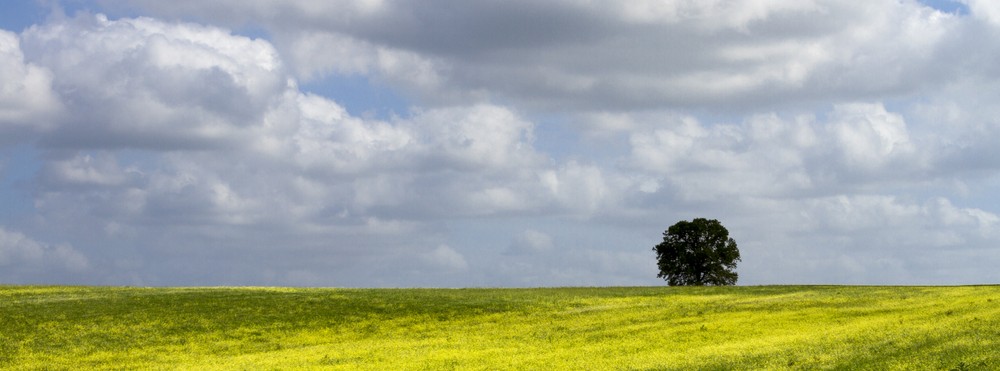
“Turn left at the big cottonwood.” “Go another mile past the pole with the red paint.” “You’ll see the old barn. Keep going another half mile.”
More often than not, simple, mundane things become our wayfinders. They take on a significance beyond what they actually are. They become place markers. Guideposts. They help you know where you are.
On the plains there often aren’t many things to interrupt the horizon so when something does, you tend to notice, even if only subconsciously. Every thing matters. The tree isn’t simply a tree. It’s the tree. The pole isn’t just another utility pole. It’s the one someone painted years ago so a neighbor could find the right turn after dark.
When I left North Dakota for graduate school in Wisconsin, I encountered something I hadn’t expected.
Trees.
Thousands of them. Millions of them. Beautiful forests. Rolling hills. Roads that curved instead of stretching toward a distant horizon. Everyone talked about how beautiful it was and they were absolutely right. It was really beautiful. But I remember feeling almost disoriented.
The trees blocked my view. If I wanted to see the sky, I had to look up. I couldn’t look ahead. The horizon was often obscured.
Perhaps at a more fundamental level, I realized that a person could no longer say “I live by the tree”. Because there were trees everywhere. Which meant I couldn’t really see any of them. And the difficulty of seeing any one thing in a singular way actually made me uneasy. In a way, it was a place that was harder to know.
That realization stayed with me.
Different landscapes teach us different ways of seeing. A forest invites you to experience the whole. The prairie invites you to notice every part.
I was 25 when I first became conscious of that difference. I’ve thought about it ever since.

Conversations about capacity tend to focus on resources. More staff....
Read More
Alignment is easiest at the beginning. At the launch of...
Read More
Self-reflection is often treated as something extra. A leadership luxury. A...
Read More